


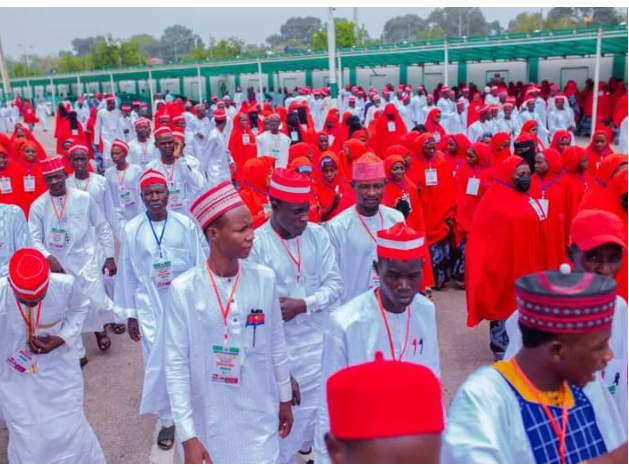
The Kano State Government says its mass wedding programme has helped vulnerable residents overcome financial barriers to marriage while promoting family stability, social cohesion and economic empowerment.
The initiative, popularly known as “Auren Gata,” was introduced through the Kano State Hisbah Board and supported by the administration of Governor Abba Kabir Yusuf as part of its social intervention programmes.
Read also: CITAD Calls for Immediate Release of Arrested IBBUL Student
The programme targets eligible men and women, including spinsters, widows and divorcees who face difficulties in getting married because of economic challenges.
The state government said the initiative was designed to enable beneficiaries establish families in accordance with Islamic teachings and the cultural values of Kano State.
In October 2023, the administration conducted the first phase of the programme, bringing together 1,800 couples selected from the 44 local government areas of the state.
The beneficiaries, numbering 3,600 men and women, were supported with household items, foodstuff, clothing and other materials to enable them begin their married lives with reduced financial pressure.
Governor Yusuf, while speaking at the time, described the initiative as part of his administration’s commitment to strengthening families and preserving the social and cultural values of the people.
He said the programme was intended to provide couples with an affordable opportunity to formalise their unions while strengthening social bonds across the state.
The second phase, which produced 1,500 couples, was recently conducted at the Kano Central Juma’at Mosque within the Emir’s Palace and officiated by Governor Yusuf.
At the ceremony, the governor described the mass wedding as a major social intervention designed to restore hope among vulnerable citizens and promote responsible family life.
Yusuf said the programme was also aimed at reducing the financial difficulties associated with marriage and helping beneficiaries establish stable homes based on Islamic principles.
During the solemnisation, the governor represented the first groom and formally sought the hand of the bride from her guardian, the Emir of Kano, Khalifa Muhammadu Sanusi II, who accepted the proposal in accordance with Islamic rites.
Earlier, the Emir delivered the Friday sermon, urging the newly married couples to build their homes around faith, patience, mutual respect and compassion.
He stressed that stable families were essential to the development of a peaceful and prosperous society.
The Commander-General of the Kano State Hisbah Board, Sheikh Aminu Ibrahim Daurawa, said the beneficiaries underwent screening and counselling before being admitted into the programme.
According to him, the authorities ensured that the necessary religious and legal requirements were fulfilled before the marriages took place.
The Chief Imam of Kano, Prof. Sani Zahraddeen, prayed for divine guidance, blessings and lasting peace for the couples.
One of the beneficiaries, Haruna Bashir, attracted particular attention after losing his wife and six children in a deadly attack at Dorayi Chiranchi Quarters in Kano on January 17, 2026.
Bashir has now married Nabila Kabiru Yunusa through the government-backed programme.
Read also: Lawan Ahmed Mohammed Emerges Emir of Gumel
Following the wedding, the state government organised a reception for the 1,500 beneficiaries, where they received furniture, foodstuff and empowerment packages.
Yusuf urged the couples to protect the sanctity of marriage and conduct their family affairs in accordance with the Qur’an and the Sunnah of Prophet Muhammad (Peace Be Upon Him).
He advised them to demonstrate mutual respect, patience and tolerance, noting that those values were necessary for peaceful and lasting marriages.
The governor disclosed that the state had spent more than N1.5 billion on the programme, covering medical examinations, counselling, dowry, empowerment grants, furniture, food and other forms of assistance.
He said each beneficiary couple received N100,000 as dowry and another N100,000 as a capital grant to support small-scale businesses and encourage self-reliance.
The couples were also provided with beds, mattresses, household items and essential commodities to ease the cost of starting their new homes.
According to the governor, the beneficiaries underwent medical screening and counselling sessions designed to prepare them for the responsibilities associated with marriage.
Yusuf said the Auren Gata programme was among the commitments he made during his 2023 campaign tours across the state’s 44 local government areas.
The Commander-General of the Hisbah Board said the initiative had attracted attention beyond Kano because of its focus on supporting couples financially while preparing them for the responsibilities of family life.
Similarly, the Chairman of the North-West Governors’ Forum and Katsina State Governor, Umar Dikko Radda, commended the Kano administration for the programme.
Radda described the initiative as a practical intervention aimed at improving the welfare and living conditions of vulnerable residents.
Representing Islamic scholar Sheikh Abdullahi Bala Lau, Barrister Kabir Haruna Umar Gombe said programmes of this nature could help address some of the social challenges associated with unemployment and idleness among young people.
Other Islamic scholars at the event also commended the government and urged the beneficiaries to remain committed to their marriages.
Some beneficiaries, including Bashir, Muhammad Tahir, Amina Aminu and Aliyu Ibrahim, expressed appreciation to the state government for supporting them to overcome the financial obstacles that had prevented them from getting married.
They appealed to the government to expand the initiative so that more people facing similar challenges could benefit.
The beneficiaries said the government’s assistance had provided them with the dowry, wedding necessities, household items and start-up capital needed to begin their new lives.
Bashir, who received additional support from the state government after the loss of his family, expressed gratitude for the assistance, saying the government had helped him rebuild his life.
Observers described the mass wedding programme as a significant social intervention capable of addressing some of the economic barriers to marriage in the state.
Read also: Kano Loses N1.1bn in Court Ruling Over Alleged Corruption
They also argued that helping vulnerable people establish stable families could contribute to social stability, reduce idleness among young people and create opportunities for beneficiaries to participate in economic activities.
The analysts noted that the combination of marriage support and the N100,000 capital grant could give beneficiaries an opportunity to pursue small businesses and work towards financial independence.
