


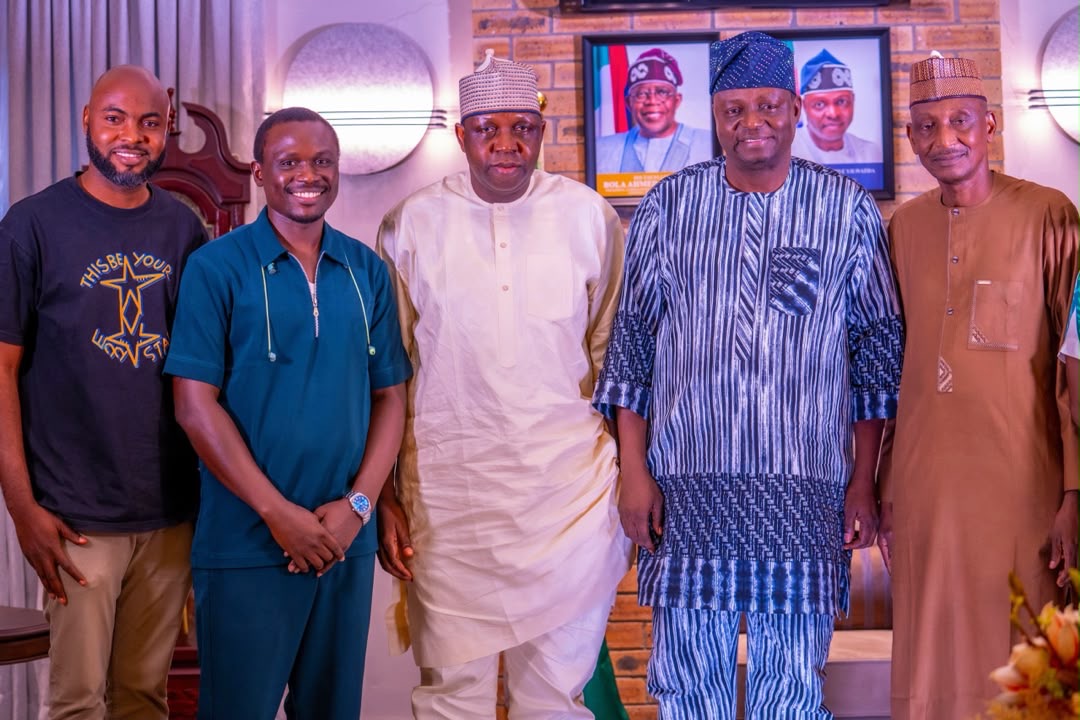
The Nationalist Magazine Team of Project 774 Network has endorsed the position of the All Progressives Congress (APC) National Chairman, Professor Nentawe Yilwatda, that state governments have a critical role to play in achieving President Bola Ahmed Tinubu’s $1 trillion economy vision.
Yilwatda had outlined a national economic strategy centred on deep seaports, highways, railways, gas pipelines, electricity, solid minerals, agriculture and industrial zones, stressing the need for states and local governments to connect federal infrastructure with local production, businesses and markets.
Read also: US Military Explores Limited Options for Nigeria Intervention
In an interview with the Nationalist Magazine Team, represented by the National Coordinator, Muhammad Ibrahim, and the National Secretary, DIG Mohammed Usaini Gumel (rtd.), the network said coordinated efforts among the three tiers of government would be essential to translating the economic ambition into jobs, increased productivity and improved living standards.
Gumel, who is also the Jigawa State Coordinator of the Security and Intelligence Committee of the Presidential Campaign Council (PCC), said governors across party lines were pursuing projects capable of supporting the national economic agenda.
“Across party lines, governors are pursuing projects that speak to parts of this agenda. Their initiatives vary in scale and maturity. Some facilities are operating; others have received approvals, investor commitments or feasibility support,” he said.
He stressed that announced projects must progress to financing, construction and operation before their economic benefits could be assessed.
Seaports to expand trade opportunities
The team identified several maritime projects across the country as potential drivers of trade, manufacturing and industrial development.
In Lagos, Governor Babajide Sanwo-Olu is consolidating the Ibeju-Lekki corridor around the operational Lekki Deep Sea Port, the Lekki Free Trade Zone and supporting infrastructure.
Ogun State Governor Dapo Abiodun is advancing plans for the Olokola Deep Seaport and a proposed Blue Marine Economic Zone, while Ondo State Governor Lucky Aiyedatiwa has moved the proposed Port of Ondo forward through an agreement signed in March 2026.
Other projects include the Ibom Deep Sea Port in Akwa Ibom, the Bakassi Deep Seaport in Cross River, the proposed Agge Deep Seaport in Bayelsa and the Azumini-Obeaku Seaport and Inland Waterways Corridor in Abia State.
According to the team, the projects could broaden access to international markets and strengthen regional trade if supported by adequate roads, railways, electricity, customs facilities and industrial investments.
It, however, noted that feasibility studies, approvals and investment commitments must translate into funded construction and operational facilities to deliver lasting economic benefits.
Reliable electricity key to industrial growth
Gumel described reliable electricity as another essential requirement for achieving the $1 trillion economic target, noting that gas infrastructure and state electricity reforms could support industrialisation.
He cited the Ajaokuta-Kaduna-Kano gas pipeline as infrastructure with the potential to support power generation, fertiliser production and manufacturing in northern Nigeria.
Bayelsa State has commissioned a 60-megawatt gas-fired independent power plant, while Imo State is developing its electricity market through the Imo State Electricity Regulatory Commission.
In Rivers State, an 11.9-megawatt solar mini-grid has been supported at Bolo in Ogu/Bolo Local Government Area in partnership with the Rural Electrification Agency.
“These efforts show different ways to expand supply,” Gumel said, adding that electricity generation must be accompanied by reliable distribution, fair pricing, effective regulation and consumer protection.
He said the ultimate measure of success would be the availability of dependable electricity to businesses, schools, healthcare facilities and communities.
Mineral processing to create local value
The team also highlighted solid minerals as an opportunity to diversify the economy, provided mining activities generate local employment, processing opportunities and community benefits.
It cited a reported $250 million lithium mining and processing investment in Nasarawa State, as well as a reported $200 million lithium project in Zamfara State.
Kaduna State was also identified as pursuing mineral development through its mining roadmap and the Kaduna Mining Development Company.
Gumel said such investments required transparent monitoring, environmental safeguards, skills development and meaningful benefits for host communities.
Read also: Kano APC Receives Shekarau, two Others
He stressed that mineral extraction should be accompanied by local processing and job creation rather than focusing solely on the removal of raw materials.
Jigawa strengthens agriculture and investment
The team described Jigawa State as an example of how agricultural policy, renewable energy and industrial development could be combined to support economic growth.
Governor Umar A. Namadi’s administration has adopted a 2024–2030 Agriculture Policy aimed at improving food security, creating jobs, attracting private investment and expanding agribusiness.
The state presented investment opportunities at the second Jigawa Economic and Investment Summit, J-INVEST 2026, held in Dutse in July. According to InvestJigawa, the summit’s deal room recorded about $140 million in investment commitments across renewable energy, hospitality and livestock development.
The summit also featured proposals for a 100-megawatt solar power plant, smallholder agricultural financing and private-sector investment in wheat and sesame value chains.
In October, the State Executive Council approved ₦7.465 billion for agricultural mechanisation equipment and an integrated Agricultural Hub.
The package includes 100 four-wheel-drive tractors and implements, while the proposed hub is expected to provide equipment maintenance, farmer training, input storage, produce aggregation and post-harvest support.
Plans to develop the Maigatari International Livestock Market into a modern livestock exchange, alongside proposed meat and dairy processing facilities, were also identified as opportunities to strengthen agricultural value chains.
“The next measure of progress will be whether investment interest becomes funded facilities, operating businesses and predictable markets for producers,” Gumel said.
He added that the success of these initiatives would depend on effective implementation, transparent project monitoring and sustained engagement with farmers, investors and host communities.
Northern states expand production opportunities
The team also identified Niger and Kano states as important contributors to northern Nigeria’s agricultural and industrial development.
Niger State Governor Mohammed Umaru Bago has prioritised large-scale agriculture, mechanisation, irrigation and agro-industrial development, including shea processing.
In Kano, Governor Abba Kabir Yusuf’s administration is pursuing market modernisation, support for small and medium-sized enterprises, improvements to industrial estates and agro-processing initiatives.
The team said stronger road and rail connections, dependable electricity and gas-based industrial development could further support Kano’s commercial role and expand access to markets in northern Nigeria and the Sahel.
Gumel emphasised that these opportunities would require adequate infrastructure, security, prepared industrial land and predictable business regulations.
Project delivery must determine success
The team said the projects being pursued by governors across different political parties reflected opportunities to connect maritime infrastructure, energy, mineral resources and agricultural production into a more integrated national economy.
However, it stressed that progress should be measured by tangible results rather than announcements and investment pledges.
“Feasibility studies need to lead to bankable designs; memoranda and investment commitments need to progress to financing and construction; commissioned power plants need reliable fuel and distribution; and mining projects need to demonstrate jobs, environmental safeguards and community benefits,” Gumel said.
He added that state governments must work with federal agencies to improve infrastructure connectivity, strengthen security, protect property rights and establish transparent investment incentives.
For Project 774 Network, the ultimate measure of the economic vision would be its impact across Nigeria’s 774 local government areas.
“A factory with reliable power, a farmer able to reach an aggregation or processing centre, a young person gaining skilled work, a transporter moving goods more efficiently, and communities receiving fair value from the resources around them—these are the kinds of outcomes that will show whether the vision is working,” he said.
Read also: Appointment of New Service Chiefs Normal- Presidency
Gumel said cooperation between the Federal Government and state administrations would be necessary to connect national infrastructure with the distinctive economic strengths of individual states.
“If those efforts lead to operating assets, productive businesses and accountable local benefits, the one-trillion-dollar goal can become a practical programme of production, trade, employment and shared prosperity,” he added.
