


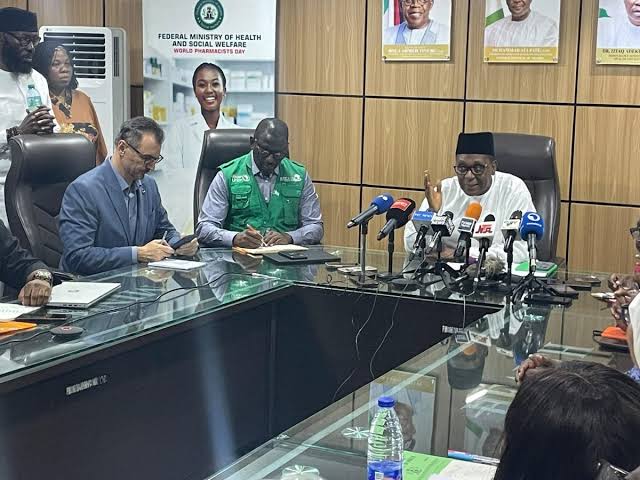
The Federal Government has assured Nigerians that there is no evidence of community transmission of Ebola Virus Disease (EVD), saying the country’s response remains focused on containing the single imported case as the infected patient continues to improve.
The Coordinating Minister of Health and Social Welfare, Professor Muhammad Ali Pate, gave the assurance on Thursday during a ministerial press briefing on the outbreak, noting that contact tracing, isolation and surveillance had been intensified to prevent further spread.
Read also: Nigeria Launches Strategy to End Child Marriage
Pate said the patient, who developed symptoms a few days after arriving in Nigeria, was responding positively to treatment, with laboratory results indicating significant improvement.
“Today, I spoke to the clinicians and I understand that her lab results are showing great improvement and there’s a possibility that she would recover from this,” he said.
He, however, stressed that the patient would remain under close medical supervision until full recovery, adding that health authorities would not relax their efforts despite the positive development.
The minister explained that the infection was classified as imported based on the patient’s travel history, noting that she entered Nigeria without symptoms before falling ill days later.
He said contact tracing commenced immediately after confirmation of the case, with health officials identifying individuals who had contact with the patient at hospitals, a private clinic and her household.
According to him, the contacts had been categorised according to their level of exposure, with high-risk individuals placed in a designated quarantine facility and others managed under appropriate public health protocols.
“Our focus is on the contact tracing and ensuring that we know exactly where those contacts are and it doesn’t go into the communities. And at this moment, there is no evidence to indicate that,” Pate said.
He disclosed that the Nigeria Centre for Disease Control and Prevention (NCDC) was coordinating the national response through the incident management system in collaboration with the Federal Capital Territory Administration and other relevant agencies.
The minister added that the Presidential Task Force, the Nigeria Governors’ Forum and the National Economic Council, chaired by Vice-President Kashim Shettima, had been briefed to ensure a coordinated response.
He said all state governments had been notified of the outbreak, explaining that most states already had Ebola response plans developed with NCDC guidance, while those yet to complete theirs had been directed to do so without delay.
Pate also revealed that the Federal Government had released additional resources to the NCDC to strengthen containment activities and was mobilising more domestic funding to improve national preparedness and emergency response capacity.
He said consultations with state commissioners of health and information would continue to promote coordinated action and consistent public communication.
On Nigeria’s diagnostic capacity, the minister said the country detected and confirmed the infection, notified the World Health Organisation (WHO) and activated emergency response measures within 24 hours of notification.
He added that the government was working to sequence the virus’s genome to obtain further scientific information, with Professor Christian Happi of Redeemer’s University invited to support the NCDC in the exercise.
Read also: UNICEF Rallies Support for Exclusive Breastfeeding
“The capabilities are in country and the investments that have been made to get us here are bearing fruit,” he said.
Pate said the WHO, Africa Centres for Disease Control and Prevention (Africa CDC) and other international technical partners were providing support, including experienced experts in Ebola response.
He added that traditional and religious leaders had been mobilised to educate communities and encourage Nigerians to rely on verified health information.
The minister explained that Ebola does not spread through the air but through direct contact with the body fluids of an infected person. He urged healthcare workers to strictly observe infection prevention and control measures when attending to patients.
He advised Nigerians to wash their hands regularly, avoid contact with the body fluids of suspected or confirmed cases and promptly report symptoms such as fever, headache and muscle pain, particularly when accompanied by a relevant travel history.
Pate further disclosed that federal hospitals and health facilities in the FCT had been directed to prepare isolation centres and strengthen infection prevention measures, while state governments were encouraged to make similar arrangements.
He also urged private healthcare providers to remain vigilant and promptly report suspected cases to public health authorities, noting that the confirmed patient had initially visited a private medical facility.
Addressing concerns about conferences and other major public gatherings, the minister said there was no current justification for cancelling or altering planned events, as the outbreak remained under control.
“At this moment, there is no indication that requires us to alter the course of large gatherings that have been planned, but if the situation changes, we’ll make a determination,” he said.
Pate called on political leaders to avoid politicising the outbreak, stressing that public health concerns should unite Nigerians across political, ethnic and religious lines.
He also cautioned against spreading misinformation, particularly on social media, warning that false claims could undermine containment efforts and encourage people under isolation or quarantine to disregard health directives.
“The alternative to trusting the expert is a tragedy,” the minister said, urging journalists and members of the public to obtain information from verified health authorities.
On border surveillance, Pate said screening at Nigeria’s entry points was being strengthened in line with WHO guidelines and the International Health Regulations.
He said additional support had been requested for port health services, including ensuring that thermal scanners were functional and that travellers were screened according to the risk classification of Ebola-affected countries.
Read also: DR Congo Begins Ebola Vaccination Campaign
The minister assured Nigerians that the government would continue to monitor the situation, while the NCDC would maintain daily emergency response meetings and provide regular updates as investigations progressed.
He urged Nigerians to cooperate with health authorities by complying with contact tracing, isolation and quarantine measures to prevent further spread of the virus.
