


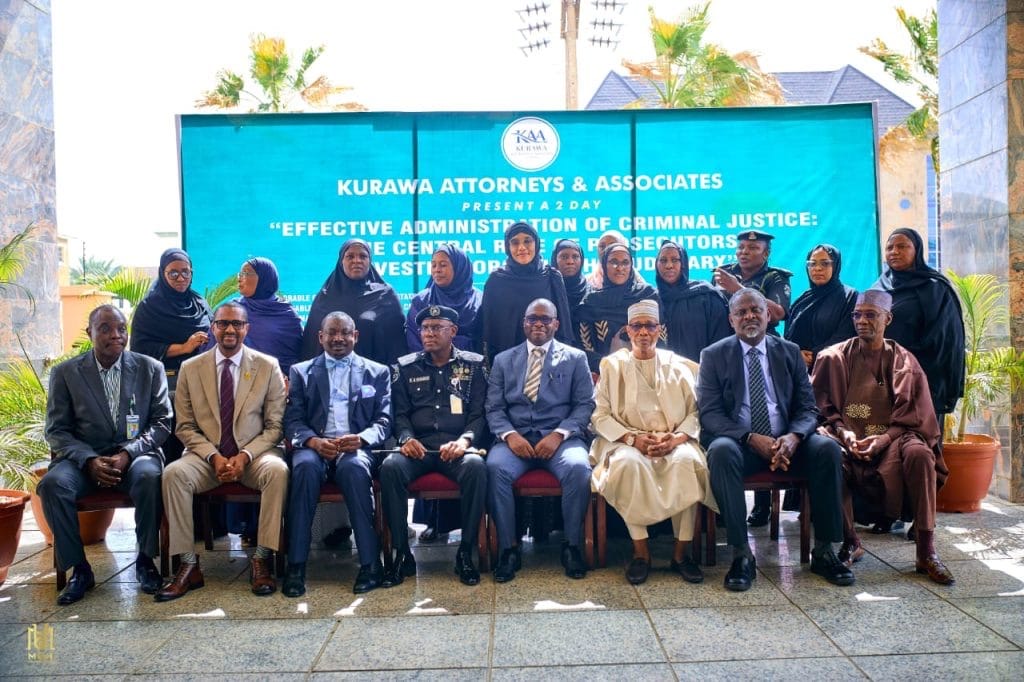
Kurawa Attorneys and Associates has called for urgent reforms in Nigeria’s criminal justice system to address prison congestion, delays in criminal trials and barriers to access to justice.
The call was made at a two-day training programme on the Effective Administration of Criminal Justice: The Central Role of Prosecutors, Investigators and the Judiciary, organised by the firm in Kano to improve professional practice and strengthen public confidence in the justice system.
Read also: KanSLAM Pushes Proper Use, Monitoring of MNCH Budget Funds
Speaking at the programme, the convener, Sadiq Sabo Kurawa, said stronger collaboration among investigators, prosecutors, judicial officers and private legal practitioners was essential to ensuring speedy, fair and accessible justice.
He stressed that access to justice should not depend on an individual’s social or economic status, adding that criminal justice administration was a collective responsibility that affected the entire society.
“Any society that is lawless is a chaotic society,” Kurawa said, emphasising the need to strengthen justice institutions and uphold the rule of law.
He expressed concern over prison congestion and the prolonged detention of suspects awaiting trial, particularly those allegedly held for months without legal advice or arraignment before a court.
Kurawa urged private legal practitioners to provide pro bono services to indigent suspects who could not afford legal representation, noting that the demand for assistance remained high despite the availability of legal aid services.
He also called on prosecutors in the Ministries of Justice and police investigators to exercise greater diligence in handling criminal cases, saying professional ethics and effective coordination were necessary to prevent avoidable delays and protect suspects’ rights.
The Kano Zonal Director of the Economic and Financial Crimes Commission (EFCC), Friday Ebelo, also stressed the importance of cooperation among investigators, prosecutors and the judiciary while maintaining the independence of each institution.
He explained that investigators were responsible for gathering credible evidence, prosecutors for objectively determining whether cases should proceed to trial, and judges for evaluating evidence and delivering decisions in accordance with the law.
“The investigators, the prosecutors and the judiciary are one body that forms the justice system,” Ebelo said, adding that cooperation must not compromise the independence of the institutions.
He identified professional training, ethical standards, forensic investigation, digital evidence collection, effective case management and adequate resources as critical to improving criminal justice administration.
Ebelo advocated the adoption of modern technology in investigations and court proceedings, while cautioning that its use must respect privacy and other fundamental rights.
Read also: Kano Quintuplets Mother Dies After Childbirth
He also underscored the need to protect witnesses, whistleblowers, victims and investigators, alongside transparent procedures and accountability mechanisms to address corruption, misconduct and abuse of authority.
According to him, efforts to speed up criminal trials must not undermine fairness.
“Speed without fairness becomes an oppression,” he said, stressing that criminal justice reforms should protect society, ensure accountability, safeguard innocent persons and sustain public trust in justice institutions.
In his remarks, the Kano State Deputy Governor, Murtala Sule Garo, represented by a Permanent Secretary, Alhaji Bashir Ado Gaya, highlighted the importance of effective criminal justice administration to national development and the protection of citizens’ rights.
Garo reaffirmed the state government’s commitment to supporting initiatives aimed at strengthening the justice sector and improving the administration of justice.
In a virtual presentation, former Chairman of the Independent National Electoral Commission (INEC), Professor Attahiru Jega, spoke on institutional integrity, accountability and public trust in the justice system.
Jega identified fairness, equality before the law, timely trials, access to justice, judicial independence and institutional accountability as essential foundations for public confidence.
He recommended ethical leadership, continuous capacity building and merit-based recruitment and appointments across justice institutions to strengthen professionalism and integrity.
The former INEC chairman also called for judicial independence backed by fair, timely and credible disciplinary procedures, increased investment in digital justice systems and measures to make justice more accessible and affordable to vulnerable groups.
He further advocated continuous reforms, periodic reviews of codes of conduct and stronger protection of the rights of accused persons.
The training brought together judges, magistrates, prosecutors, police and anti-corruption investigators, legal practitioners, academics and other justice-sector stakeholders.
It featured expert presentations, inter-agency discussions and practical case studies aimed at clarifying institutional responsibilities, improving evidence handling and identifying solutions to delays in criminal proceedings.
Read also: Kano NAWOJ Celebrates Khadijah Aliyu’s Award-Winning Health Reporting
Participants are expected to develop recommendations to improve coordination, strengthen professional standards and ensure that criminal cases are handled efficiently and fairly in accordance with the law.
The programme highlighted the need to balance efforts to combat crime with the protection of fundamental rights, ensuring that justice is delivered promptly without compromising due process or the presumption of innocence.
