


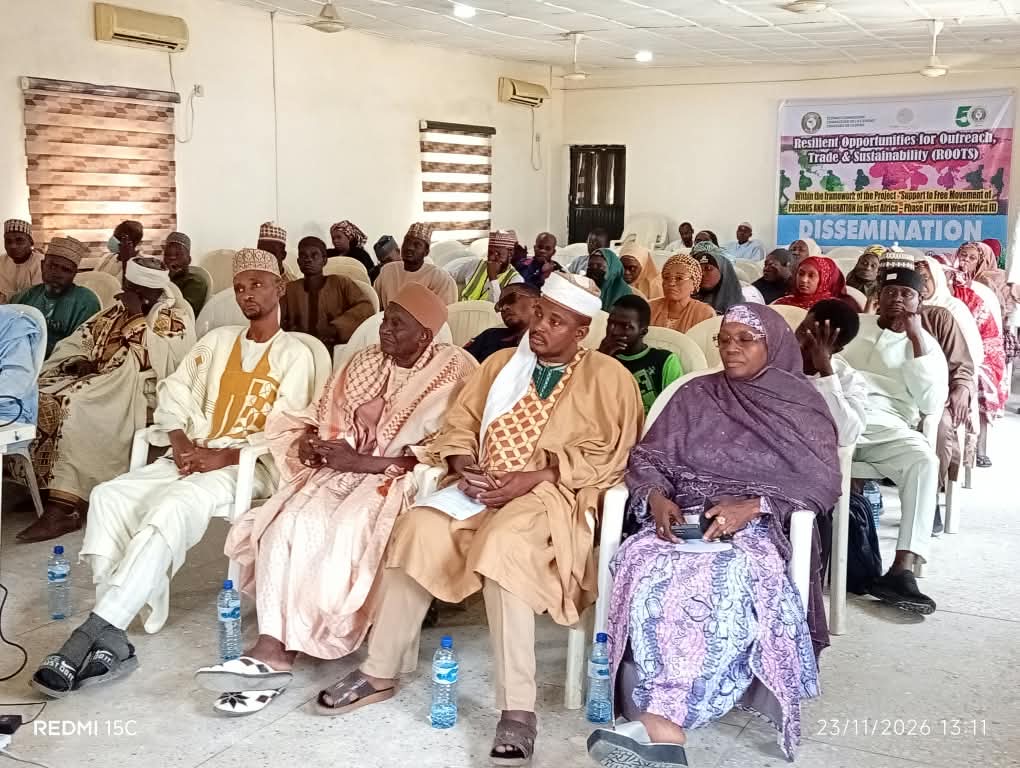
The Resilient Opportunities for Outreach, Trade and Sustainability (ROOTS) Project has been described as a major intervention for promoting women’s empowerment, entrepreneurship and climate-smart agriculture to address irregular migration and improve livelihoods in Kano State.
Participants at a project dissemination event in Kano commended Adolescent Health and Information Projects (AHIP) and the International Organization for Migration (IOM) for providing alternative livelihood opportunities for women, youths, migrant returnees and small-scale cross-border traders.
Read also: Nigeria Customs Deploys AI to Combat Fake News, Online Scams
The initiative seeks to strengthen climate resilience, promote inclusive livelihoods and encourage safe migration while improving income stability and access to decent economic opportunities.
It also raises awareness of the ECOWAS Protocol on Free Movement as part of efforts to reduce vulnerability to unsafe migration and human trafficking.
At the event, stakeholders reviewed the project’s achievements, challenges, success stories, lessons learned and findings from its endline assessment.
Sharing his experience, Habibu Abdullahi from Dakata recounted his dangerous journey through the Sahara Desert to Libya, with the intention of reaching Spain.
He said the journey was difficult and risky, adding that several migrants lost their lives while crossing the desert.
Abdullahi explained that his participation in the ROOTS Project had broadened his understanding of the dangers of irregular migration and encouraged him to consider legal migration channels whenever necessary.
Similarly, Binta Auwalu from Dawakin Kudu narrated the hardship and exploitation she experienced while travelling to Niger Republic.
She explained that traders who purchased their goods in Nigeria failed to pay them, while their journey was further characterised by mistreatment and unsafe transportation.
According to her, an overloaded vehicle conveying passengers was involved in an incident that resulted in the death of one passenger, whose body was reportedly abandoned in the Sahara Desert.
The Ward Head of Bunkure, Alhaji Aminu Bunkure, who represented the District Head, commended AHIP and IOM for selecting the community as one of the project’s intervention areas.
He said women, youths and other community members had benefited from training in climate-smart agriculture and the distribution of improved seeds, resulting in increased harvests and better livelihoods.
Read also: Customs PR Conference Bridges Academia, Practice, Builds Skills
Alhaji Bunkure noted that beneficiaries had adopted not only conventional farming methods but also backyard and container farming techniques introduced through the project.
He said the intervention had improved women’s income, food availability and economic independence, while urging government agencies, philanthropists and development partners to sustain support for interested farmers.
Also speaking, Maijidda Dalhatu of the National Orientation Agency (NOA) urged parents and philanthropists to equip children with entrepreneurial skills to promote self-reliance.
She emphasised the need to instil good moral values in children, saying this would help address societal vices and promote good governance.
Dalhatu also called on citizens to reject vote buying and voter apathy, describing voting as an important civic responsibility that should be exercised responsibly.
In her goodwill message, Professor Amina Lawan Mustapha of the Centre for Dryland Agriculture, Bayero University Kano, said the knowledge acquired through the project would help discourage irregular migration by providing women with sustainable alternative livelihoods.
She said beneficiaries had received training in crop production, storage, utilisation and marketing, urging them to apply the knowledge to improve agricultural productivity and income.
Earlier, the AHIP ROOTS Project Lead, Halima Kasim Usman, said the intervention had reached women smallholder farmers, informal cross-border traders, migrant returnees, internally displaced persons and youths at risk of irregular migration.
She added that traditional leaders, policymakers, civil society organisations and private-sector stakeholders had also been engaged.
According to her, the project had reached more than 600,000 community members through awareness campaigns, media engagements and community advocacy.
Among its achievements, she said, were the provision of improved seeds and climate-smart agricultural training for women farmers, strengthening the business and financial management skills of migrant returnees, and training women and youth groups as safe migration advocates in schools and communities.
The project also facilitated community action plans on migrants’ rights, strengthened policymakers’ capacity on gender-responsive migration governance and supported ongoing efforts to develop a draft bill on inclusive migration governance.
Read also: Nigeria Customs Generates N88.9bn, Seizes Goods Worth N2.16bn in Kano
Traditional rulers and other community stakeholders called on the government and development partners to provide additional support to sustain and expand the initiative, which they said was creating alternative livelihood opportunities for potential migrants, returnees and vulnerable groups.
The ROOTS Project is designed to address the underlying causes of irregular migration through community awareness, livelihood empowerment, institutional engagement and the promotion of alternative economic opportunities.
