


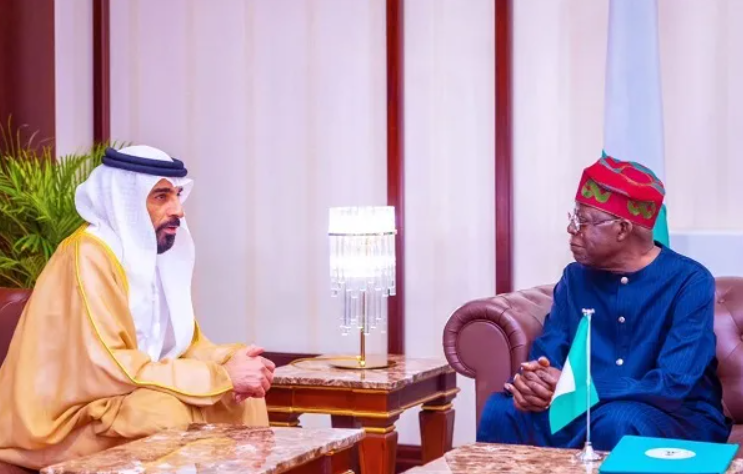
Nigeria and the United Arab Emirates (UAE) are set to seal a Comprehensive Economic Partnership Agreement (CEPA) at a bilateral meeting between President Bola Ahmed Tinubu and the President of the UAE, Sheikh Mohamed bin Zayed Al Nahyan, on the sidelines of the ongoing Abu Dhabi Sustainability Week in Abu Dhabi.
Speaking to journalists in Abu Dhabi, the Minister of Foreign Affairs, Yusuf Tuggar, revealed that the agreement is intended to institutionalise current economic relations, enhance investor confidence, and guarantee reciprocal protection for enterprises operating in both Nigeria and the UAE.
Tuggar said the CEPA is a key deliverable of President Tinubu’s engagement at the sustainability summit, adding that many investors from the UAE have long anticipated the pact, which they see as crucial to ensuring stability and certainty for their investments in Nigeria.
“President Tinubu is going to have a bilateral with the President of the United Arab Emirates, His Highness Mohammed bin Zayed Al Nahyan, and one of the things to be discussed there is the Comprehensive Economic Partnership Agreement which is expected to be signed during that bilateral meeting,” the minister said.
He explained that, beyond attracting UAE investments into Nigeria, the agreement would also safeguard Nigerian interests abroad, particularly in Dubai, where many Nigerians run businesses and factories.
“It also protects the investments of Nigerians. We have a lot of Nigerian businesses operating in Dubai. Some even have factories. This further protects them, dignifies the Nigerian and ensures that Nigerians are respected wherever they go to invest or visit,” Tuggar added.
The foreign affairs minister described Abu Dhabi Sustainability Week as a strategic platform positioned between global climate conferences, such as the recent COP, which helps participating countries move from declarations to implementation.
“The Abu Dhabi Sustainability Week happens in between the COP. You need to concretise some of the agreements that have been reached; otherwise, it just ends up being a talk shop,” he said.
Also Read: Nigeria, UAE Firm Sign Landmark Deal on Cargo Security
He noted that Nigeria’s participation was driven by the need to translate climate commitments into tangible outcomes, including funded and implementable projects, particularly in areas where the country faces a deficit in project preparation.
“This presents an opportunity to come with identified projects and try to source funding from some of the countries and organisations that are in attendance,” Tuggar explained.
On priority sectors for Nigeria–UAE collaboration, the minister identified gas development for electricity generation as a major focus, stressing that inadequate investment in converting Nigeria’s vast gas resources into power has contributed to persistent electricity outages.
“We’re looking to invest further in gas for electricity. We have a lot of gas, and we need to develop it to generate power. That is why we now have a lot of pipelines being constructed and a licensing round going on for acreage,” he said, adding that this would open more opportunities for exploration and production.
Tuggar also highlighted expanded trade relations, including agricultural commodities and manufacturing, as well as improved financial and aviation frameworks.
He recalled that challenges faced by airline operators over trapped funds were resolved after President Tinubu assumed office, easing travel and financial transactions for Nigerians abroad.
Speaking on President Tinubu’s expected address at the forum, the minister said the President would outline Nigeria’s climate change priorities, nationally determined contributions, and the drive to make climate-related projects bankable to attract global funding.
“He will talk about Nigeria’s focus in terms of deliverables, our goals and commitments, and ensuring that the projects we bring forward are viable and can convince funders,” Tuggar said.
He added that Nigeria’s engagement at the forum underscores its commitment to sustainability, not only in tackling climate change but in doing so in a way that supports long-term economic growth and development.
