


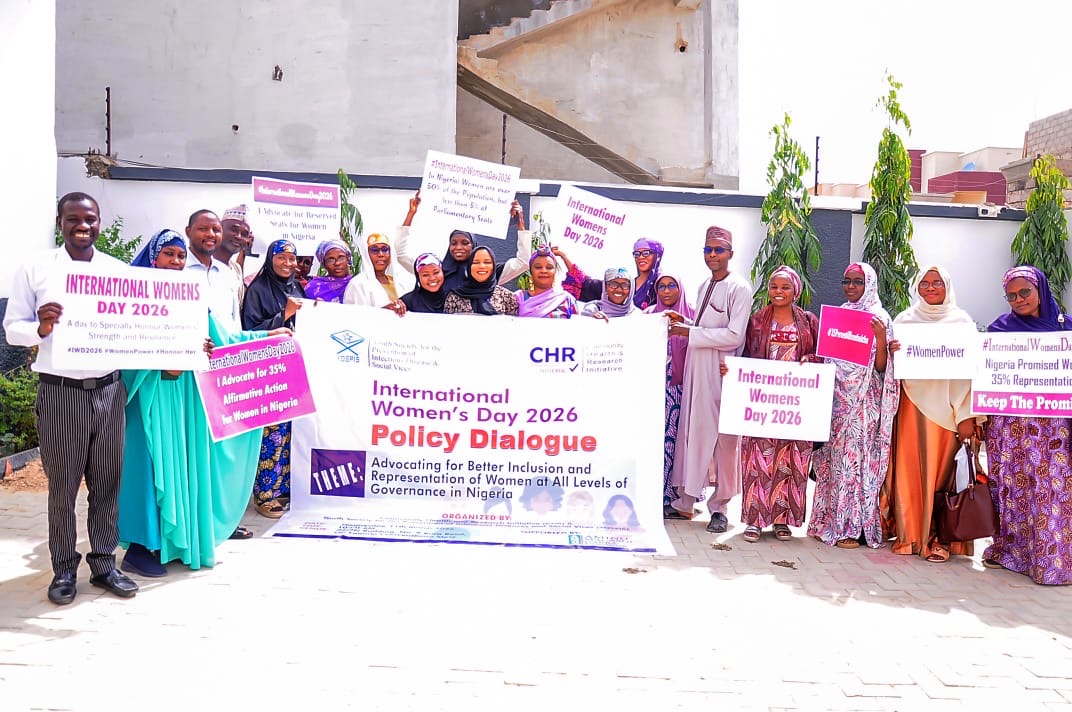
Civil society organizations have renewed calls for greater participation of women in Nigeria’s leadership, urging government at all levels to meet the 35 percent affirmative action target outlined in the country’s National Gender Policy.
The appeal was made during a policy dialogue organized in Kano by the Community Health and Research Initiative (CHR) and the Youth Society for the Prevention of Infectious Diseases and Social Vices (YOSPIS) to mark International Women’s Day 2026.
The event received support from the Aminu Magashi Garba Foundation and focused on promoting stronger inclusion of women in governance.
Presenting key findings at the dialogue, the Executive Administrator of CHR, Nafisa Shehu Ibrahim, highlighted the significant gender imbalance in Nigeria’s political leadership.
She explained that despite women constituting nearly half of the country’s population, their presence in key political positions remains very low.
According to her, since Nigeria returned to democratic rule in 1999, no woman has been elected President, Vice President, or Governor of any state.
She added that women currently occupy only 4.5 percent of seats in the 10th National Assembly, which is far below the global and regional averages.
According to her women’s representation across other levels of government remains limited.
She said women make up about 15.6 percent of ministerial appointments at the federal level, while only 5.5 percent of seats in state Houses of Assembly are occupied by women.
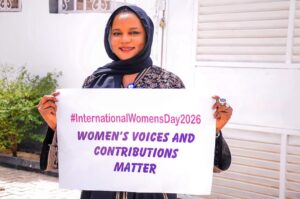
She further revealed that 13 states currently have no female lawmakers.
At the local government level, she said women secured just 23 out of the 618 chairperson positions contested during the 2024 local government elections.
“The statistics do not reflect the ability and leadership capacity of Nigerian women, noting that many women have excelled in both public service and the private sector”. She said.
Speaking during the event, the Executive Director of YOSPIS, Zainab Nasir Ahmad, called for stronger commitment from policymakers to ensure the implementation of the 35 percent affirmative action target contained in Nigeria’s National Gender Policy introduced in 2006.
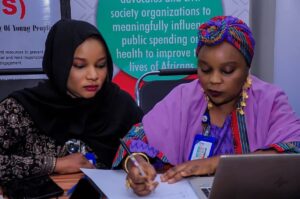
Zainab said “progress toward the goal has been slow over the years, stressing that deliberate policies, accountability mechanisms, and sustained advocacy are needed to improve women’s participation in governance”.
Both CHR and YOSPIS pledged to continue working with other civil society groups and stakeholders to strengthen advocacy efforts until the target becomes a reality.
The dialogue also featured a panel session where participants examined the major barriers preventing women from taking part in leadership and governance.
Panelists and attendees proposed practical recommendations aimed at increasing women’s representation in decision-making positions.
Participants at the event included representatives from the Kano State Ministry of Women Affairs, Children and Persons with Special Needs, members of the Nigeria Union of Journalists (NUJ), the Nigeria Association of Women Journalists (NAWOJ), media organizations, and several non-governmental and civil society groups.
The meeting concluded with a shared view that meaningful national development requires the active inclusion of women in governance and decision-making processes.
